
Crush Hour
On flattery, bribery, and the perils of giving the people what they don't want

I’ve been thinking a lot about two people whose personal trajectories have taken a sudden turn under the second Trump administration; turns that, to any ordinary mode of thinking, would appear perverse and disturbing if not also downright mystifying.
One is Brett Ratner, the Hollywood film director whose career appeared to be dead after half a dozen actresses accused him of sexual assault at the height of the #MeToo movement. And the other is Jeff Bezos, the Amazon overlord, uber-billionaire, and proprietor of The Washington Post who coined the masthead tagline “Democracy Dies in Darkness” and, for many years, was willing to bleed money to shore up a pillar of the free press and push back against Trump’s anti-democratic predations.
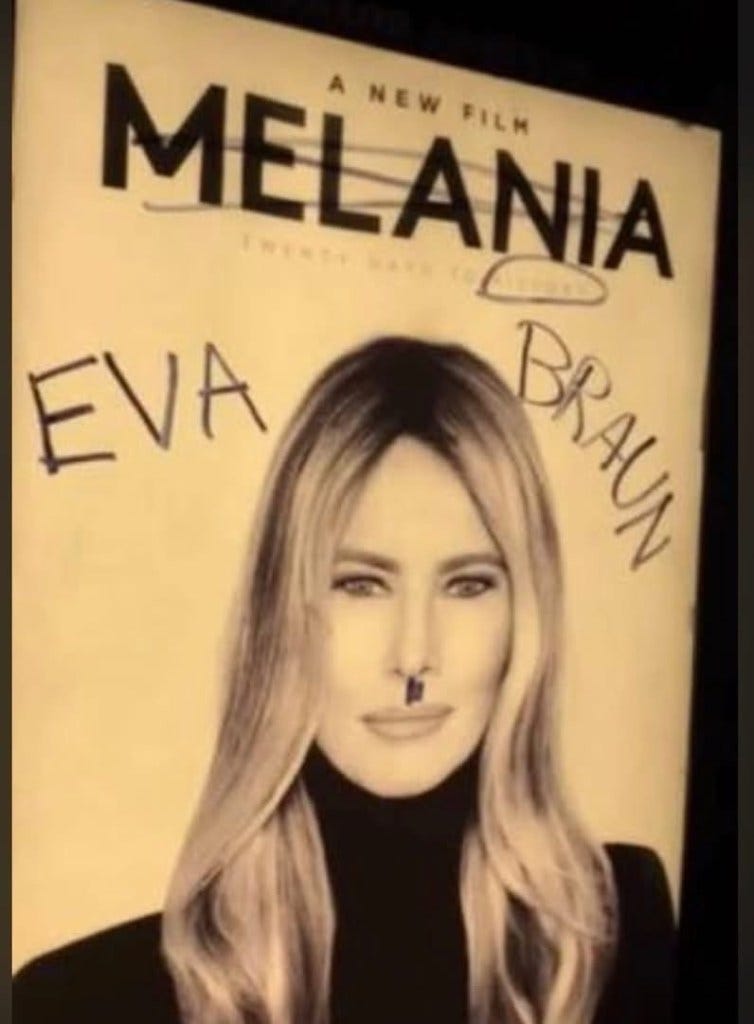
The two men are of course connected, because Ratner has reemerged as the director of Melania, Amazon’s lavish documentary about the First Lady, and Bezos has made no apology about bleeding a whole lot more money into his new, contradictory project to curry favor with (and pay a $28 million kickback to) the current occupants of the White House while at the same time bleeding The Washington Post dry.
The question is not really what happened, because that’s easy to answer. Trump happened. Rather, it’s about how and why it happened.
Ratner first.
It may be hard to believe now but once upon a time, when Ratner was still a force in Hollywood and Donald Trump was just a reality show host with an outsize ego and a reputation for driving his real estate businesses into the ground, the two men were briefly on an entertaining sort of collision course.
Ratner wanted to make a caper about a crew of African American employees at the Trump International Hotel in New York who hatch a plot to rob their famous employer blind. The movie, based on an idea from Ratner’s friend and frequent collaborator Eddie Murphy, was actually going to be called Trump Heist. We can only imagine what kind of afterlife such a film would have enjoyed under the two Trump presidencies — and the very different path to rehabilitation it might have afforded its director.
But things were destined to take a rather different turn. Trump Heist went through multiple rewrites and interventions from producers, lawyers, and studio execs until it morphed into the more harmless and forgettable Tower Heist, released in 2011. The mark was no longer Donald Trump, or anyone much resembling him, but rather a Bernie Madoff type, who angered his employees by burning up their pensions in a Ponzi scheme. (It was presumably no coincidence that Madoff, by this point, had pleaded guilty and was safely behind bars, whereas Trump was known to be litigious, vain, thin-skinned and very much at large.)
By the time filming began, Trump had in fact become an ally to the production, granting permission to use several of his New York properties. When the crew shot a scene in the underground parking lot at Trump Tower, just off Fifth Avenue, the future president took a break from the set of Celebrity Apprentice several floors up and popped in to say hello.
It was, as they say in Hollywood, the beginning of a beautiful friendship. A transactional one, anyway.
We can only guess what Ratner truly thinks of Trump or of Melania, but one word that must spring to mind reasonably often is grateful. He is not only back in the game, he’s negotiating a possible fourth film in his Rush Hour series — a prospect that seems objectively nuts when you think about the production crisis afflicting Hollywood, Ratner’s woeful reputation, and Jackie Chan and Chris Tucker’s questionable box-office sell-by dates. Objectively nuts, though, is where we all now seem to be living. Trump himself is reported to have extracted a promise from David Ellison, the MAGA-friendly head of Paramount, to greenlight the movie if Paramount manages to complete its hostile takeover of Warner Brothers and secure the rights to the franchise. Who cares if it finds an audience, as long as it makes one man in the White House happy?
Bezos is in many ways a more perplexing case because, unlike Ratner, he is not someone in an obvious position of weakness whom the president can exploit, adopt, and own. Bezos is a billionaire’s billionaire, one of the world’s richest, most powerful and recognizable men who not only has what is technically known as fuck-you money but was in fact explicit, back in Trump’s first term, about using his power and wealth and ownership of The Washington Post to fight for some version of American democracy. A “sacred trust” is the term Post staffers use to describe their institution, and to all appearances Bezos bought into it. As recently as December 2024, even as his shifting allegiances were glaringly apparent, Bezos described himself as a “doting parent” to the Post who could provide financial resources whenever the paper needed.
It’s tempting to characterize everything that has transpired since as just a hard-headed business decision. Bezos didn’t enjoy losing a $10 billion defense infrastructure contract during Trump’s first term, so the received wisdom goes, and he doesn’t want to jeopardize the $20 billion in government contracts that Amazon and his space exploration company Blue Origin hold currently. All of that is no doubt true, but there is a story behind this story, one that has to do with more profound questions of power and influence and the seismic shift that Bezos appears to have perceived in Trump’s return to the presidency.
In short, the Amazon chief is acting like a man who believes American democracy has already died and is determined not to die along with it. That is largely a metaphorical way of phrasing it – it would appear his primary goal is to remain at the center of things, however the world happens to turn. But Bezos may also be thinking of his fellow oligarchs, the ones who emerged at the dawn of Russia’s post-communist era and came to learn, sometimes to their personal cost, that their continued influence and wealth depended on their obeisance to the man in charge. One obvious point of comparison is Mikhail Khodorkovsky, the oil billionaire who regularly denounced Vladimir Putin in the early days and used his money to fund the political opposition, only to be arrested at gunpoint, charged with fraud and tax evasion and consigned to a Siberian prison for years on end.
We are fortunate not to have descended – yet -- to the level of Putin’s Russia, but in an administration that has not hesitated to promote the worst of the worst in exchange for their loyalty, or to weaponize the justice system and concoct criminal charges against its enemies, the comparison is nevertheless instructive. Business is important to a billionaire, sure, but self-preservation may be more important still.
Of course, the problem with Bezos abandoning the principles he articulated a decade ago is that his actions risk becoming their own self-fulfilling prophecy. If we treat American democracy as a dead letter, that is what it will become. If we indulge Trump’s whims — his preening self-regard, his need to be constantly flattered and lionized, his perverse upending of societal norms and his habit of championing of people accused, like him, of acts of sexual abuse — then they will indeed become an immutable fact of life.
Those of us who believe in democracy need to stay outraged and push back, whether that means, in my profession, continuing in the Washington Post’s tradition of fearless journalism, or taking to the streets, as many brave people have in Minneapolis, and before that in Chicago and Los Angeles. We don’t need billionaires to be onside, necessarily — their proliferation has itself been a feature of America’s anti-democratic drift — but we do need them, as much as possible, to avoid compounding the damage. If Bezos was too chicken-shit to keep supporting The Washington Post, he should have sold, not gutted it.
Melania gives us a glimpse of the future as Trump would like us to see it, a future in which our cultural diet — at the movies, on television, at the Smithsonian museums, at venues like the Kennedy Center — is recast in his image with the support and financial backing of a cowed elite that once despised him and everything he stood for.
We are fortunate, perhaps, that none of it is going well for him; there’s no danger, yet, of people swallowing what he’s serving up, much less pretending to like it. “A gilded trash remake of The Zone of Interest,” my Guardian colleague Xan Brooks called Melania, and the other published reviews were no less scathing. Even the Washington Post critic, Monica Hesse, managed to poke fun despite the extraordinary delicacy of her position. “If you suspect I have come here today to trash a movie about the wife of a notoriously thin-skinned, anti-journalist president that was bankrolled by the company founded by the man who also pays my salary,” she wrote, before proceeding to do almost exactly that, “NOT TODAY, SATAN. Do you think I’m a moron?”
Not today, indeed. But that doesn’t mean we shouldn’t be worried about tomorrow.